In the 1920s the Rebirth of Arts and Culture Was Centered in Harlem
News
January 28, 2022
The Harlem Renaissance: Rebirth of the Cool
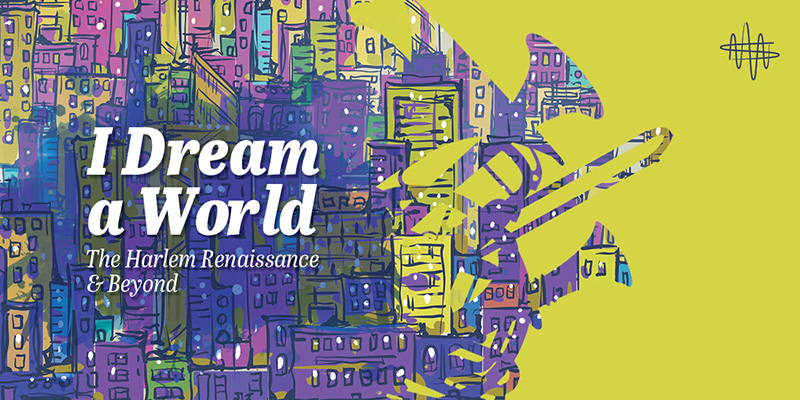
The New World Symphony presentsI Dream a World: The Harlem Renaissance and Beyond,February 1 through five at the New World Centre. The festival explores and celebrates the history and influence of the Harlem Renaissance and the epicenters of Blackness excellence that thrived across the nation during the 1920s.
Discover the Renaissance'south music, poesy, visual art, songs and impact with MTT, NWS Fellows and guests Kevin Young (Andrew W. Mellon Director of the Smithsonian's National Museum of African American History and Culture and Poetry Editor for The New Yorker), musicologist Dr. Tammy Kernodle, conductor Thomas Wilkins, pianist Michelle Cann, soprano Michelle Bradley and the Administrator Chorale of Florida Memorial University.
I Dream a World: The Harlem Renaissance and Beyond is made possible with support from the NWS Collaborations Fund, the NWS Fund for New Ventures, Dr. Matthew Budd and Ms. Rosalind E. Gorin, The Robert and Jane Cost Foundation, Keith and Renata Ward Family Fund at The Miami Foundation, and Bank of America.
Click hither for tickets.
This invitee essay was deputed for theI Dream a Earth festival.
The Harlem Renaissance: Rebirth of the Cool
On April 29, 1923 dissonance bombs fell upon the Harlem neighborhood of northern Manhattan. The stunned residents shot their heads skyward and were treated to a peculiar, futuristic (and perhaps terrifying) sight: A human being, decked out in a brilliant flight suit, leaping from an airplane before deploying a parachute and floating to the elevation of an apartment building on West 140th Street. The Blackness Eagle—Hubert Fauntleroy Julian—had landed.
This was not the first jump for the Trinidadian-born aviator; he had completed several stunts earlier of equal or greater spectacle, including a descent to earth while playing "Running Wild" on a saxophone. Julian'due south 1920s were spent, amid other things, preaching the wonders of aviation and leaping out of planes. Thinking about these feats today, Julian'south jumps seem surreal—the thought of civilians parachuting into densely populated neighborhoods seems bizarre, if non impossible. But in the context of 1920s Black America, Hubert Julian's stunts were far from out of identify. They were a testament to the boundless body of water of New Negro expression.
"The New Negro Movement"—later referred to every bit the Harlem Renaissance—wasn't a renaissance at all, simply something greater. It was forrard-thinking. Some writers, musicians, philosophers and artists might have argued that equality could be achieved through creative advancement, and while this belief was flawed in retrospect, it doubled downwardly on and ultimately proved the argument that Black America was America, that its aesthetic and academic output was integral to the cultural and political fabric of the country.
Naissance is the French word for birth; so, when affixed with the prefix "re," the discussion becomes rebirth. "Renaissance" is historically used to depict a born-again European identity; information technology unambiguously describes an artistic flourishing across the continent that radiated outward from the Central Italian Democracy of Florence. In this context, "Renaissance" connotes not innovation, but rediscovery; its usage implies passage out of the then-called Nighttime and Eye Ages of Europe and the encompass of secular themes and techniques like linear perspective and polyphony. Sculptors gazed in awe of the "lost" artistic creations of Hellenistic and Roman artists and were eager to replicate those styles in the 15th and 16th centuries. Considering this, "renaissance" can simply as hands hateful "recovery of cultural heritage that was lost." It's productivity whose success is predicated on the fixation and recovery of the past.
But Black Americans didn't lose or forget anything. Those artists and philosophers and poets and novelists; musicians and filmmakers and photographers; choreographers and historians; fashionistas and designers; chefs and inventors—and, aye, aviators—they stood, at last, acutely enlightened of the experiences and histories of generations out of the gloomy past. That memory was carried into the 20th century, and these creatives congenital on that memory and traditions. Repeatedly. For a full-bodied menses from the waning days of the Outset World State of war to the dawn of the Great Depression and across, Black America experienced a cultural supernova; a stellar explosion that didn't bespeak the expiry or even rediscovery of anything, but instead a furious effort to creatively exist unabashedly—and every bit W. E. B. Dubois would say, unforgivably—Black.
The definitions of that Blackness then, equally now, were varied. It was represented by the separatism of Garveyites. Information technology was represented by those who turned the artistic disciplines born of a White Europe back on itself, determined to trounce White America at its own ancestral game. Information technology was nowadays in those who argued such obsessions were assimilationist and ignored Blacks of lower-grade status.
A back-up: art does not make equal. This is self-axiomatic; if it were the case, the Harlem Renaissance would have drenched the White House in melanin long before 2008 or served as a straw for reparations. Just, good art does oft thrive in spite of deep inequality. Have for example The Crisis (and its offshoot, The Brownies' Book), the films of Oscar Micheaux and the music of Bessie Smith: all existed and thrived in the negative space created by a cold Whiteness. The Harlem Renaissance as a movement, along with the art that came out of it, was effortlessly (and, to outsiders, puzzlingly) cool.
There's a Yoruba word for an aesthetic concept that describes the self-assured, vaguely aloof countenance so prevalent in the sculpture and masks of that culture: Itutu. It ways "absurd." The Harlem Renaissance carried on with that aesthetic, and that absurd persisted well beyond the 1930s.
Information technology isn't an exaggeration to say White America has long had an obsession with Black culture; nor is it an exaggeration to contend that violent reactions to it are a directly result of conflicting feelings most that obsession, that the and then-called "inferior" race is cooler than the socially ascendant Whites. Black is absurd. Jazz is cool. Hip-Hop is cool. Dance that couples with these idioms is cool. Black fine art molded with casts created in Old Globe Europe conveying Black retentivity of Old World Africa— that's cool. The nutrient of Black America is cool, and it'south delicious. If none of these things were true, they wouldn't be the object of endless scrutiny and attempted emulation. Something is cool precisely because information technology isn't mainstream; so equally long as "White" occupies that default, that cool is an inherent impossibility. And so we run across not-Black patrons of the Black arts for every bit long as Black America can recollect, whether it was Whites gathering curiously on the edges of New Orleans's Congo Foursquare, or White hipsters of the 1940s emulating the unholy habits of bebop'southward patron saints. Zora Neale Hurston understood this miracle, dubbing White patrons of Black creatives "Negrotarians." Black created, White consumed; commensalism that, without good-faith dialogue and proper context, tin hands slip into parasitism. The Harlem Renaissance was merely one complication in America's cultural timepiece, but it proved a salient signal: American civilisation does not be without Blackness. And more times than not, it needs an electrical, aviary daredevil to concord gravity in contempt and give the people something at which to curiosity.

James Bennett is a full-time reporter and some-time critic who lives and works full-time in Boston and some-time in Brooklyn. Music and food are nearly important to him. At whatever given point in fourth dimension, yous can observe him frantically catching up on book-social club reading, sacrificing to the zeitgeist, cataloging records, or thinking about the next time he'll eat pâté.
Posted in: I Dream a Earth
greenbergkepon1950.blogspot.com
Source: https://www.nws.edu/news/the-harlem-renaissance-rebirth-of-the-cool/
0 Response to "In the 1920s the Rebirth of Arts and Culture Was Centered in Harlem"
Publicar un comentario